For the one who remembers absolutely everything for everyone
How To Share The Mental Load Without Starting An Argument
If you've tried talking about how much you carry but it either ends up in a row or you are told to stop nagging... and nothing's changed. Then this is for you
Get The CourseIt's not the jobs. It's the thinking about the jobs.
So you know when you're lying in bed and your brain just starts… did I sign the school trip form, we're nearly out of Calpol, it's their mum's birthday on Saturday and nobody's got a card, the kids' shoes are rubbing so they need new ones, what are we even having for tea tomorrow…
And they're asleep.
That's the mental load. It's not the doing... It's the noticing, remembering, planning, deciding and checking that happens before anything gets done. And because nobody can see it, it's so hard to explain without it sounding like you're moaning about the something.
So when you finally say "I'm doing everything" and he says "just tell me what to do"… that's the bit that makes you want to scream. Because working out what needs doing and then telling him is the job.
This course gives you a way to show him the part he can't see, without it turning into a row.
Get The CourseAnd you've probably tried to fix it:
- Maybe you've asked for help
- Maybe you've tried to "communicate better"
- Maybe you've just secretly hoped your partner would notice on their own one day
And either nothing's changed, or it's turned into an argument, or you've ended up doing it all again yourself because it was just faster.
This course isn't about doing less.
It's about not being the only one holding it all anymore.
Get The CourseHi, I'm Dr Natasha Wallace — psychologist, and mum.
I bring both to this. Clinically, I understand exactly why the mental load lands where it does, the conditioning, the nervous system, the psychology of why "just ask for help" doesn't actually work.
And personally, I live this too. I'm not teaching you something from a textbook, I'm teaching you what's actually helped in my own house, with my own husband, my own kids, my own mental load.

This is for you if:
- You're the one who remembers everything, and you're exhausted by it
- You've tried to raise this before and it's turned into a row, they say you are nagging or it's gone nowhere
- You want something practical you can actually use this week, not a slow burn over months
Most advice about the mental load doesn't actually work. Here's why.
"Communicate better." "Ask for help." "Just delegate more." You've heard all of it, and none of it tells you how, specifically, to do this.
This course is built around two simple frameworks I use in my own clinical work.
What actually changes
You're both looking at the same list. It's out of your head and on paper, so it's a thing you can point at instead of a feeling you keep trying to describe.
You can talk about it without it turning into a row about who does more or who is more tired.
And you split it in a way that actually works for the two of you - who's genuinely better at what, who's got the capacity for it right now - not with one of you ending up with all the grim jobs.
Things still get dropped sometimes, because that's real life, but they're just not all landing on you!
And the bit nobody really talks about - you stop running the list in your head at 11pm, because it's not only in your head anymore.
Get The CourseWhat's inside
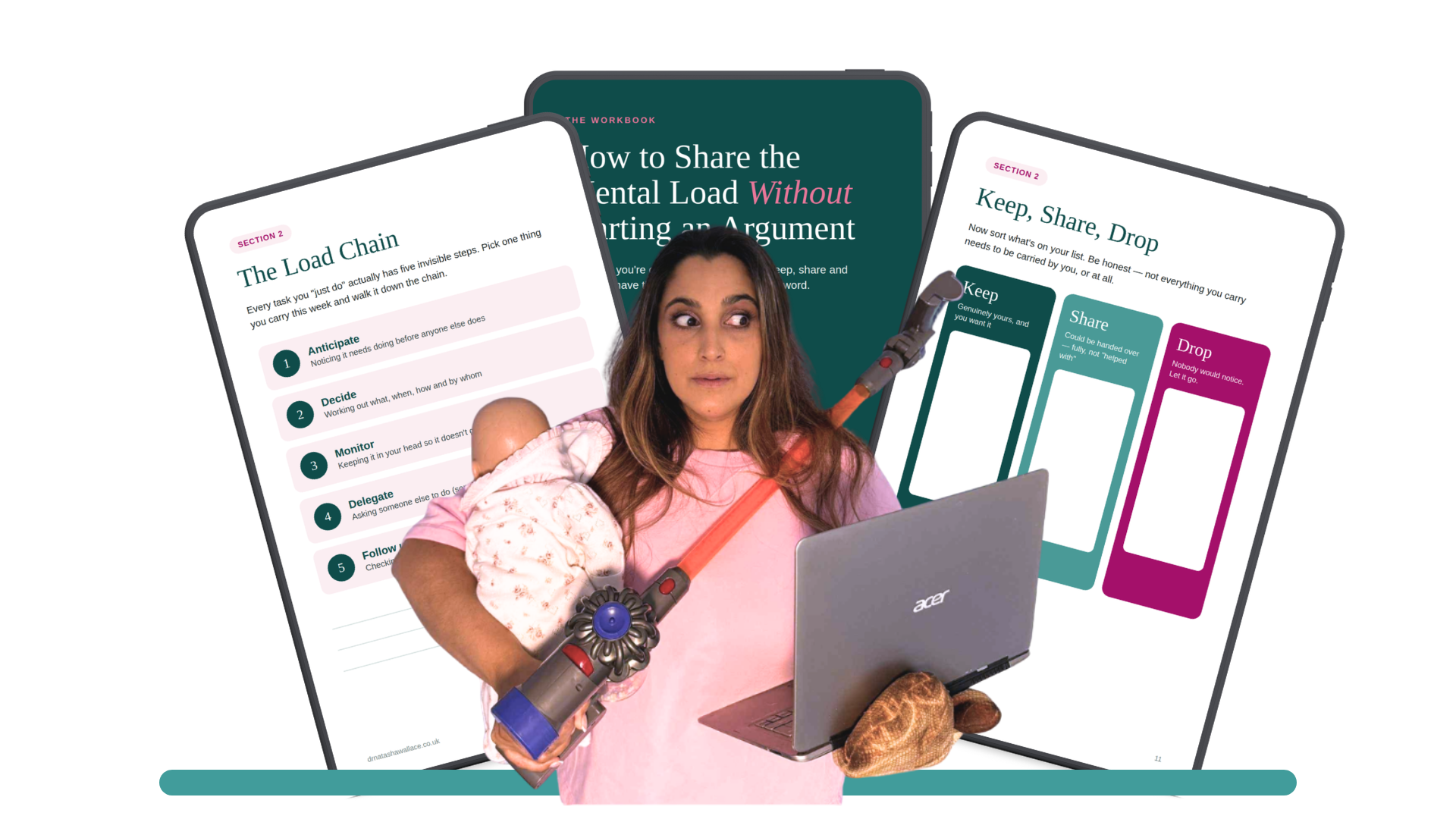
By the end of this you'll have your own mental load mapped out on paper, sorted into what's actually yours, what's ready to hand over and what needs to stop. Plus the actual words for the conversation, including what to say when they get defensive.
Short videos across 4 sections. Every video's around 5 minutes. No fluff, nothing you need an hour to sit down for.
Section 1 - What Is The Mental Load
Understand what the mental load actually is, why it landed on you specifically, and what sharing it actually means. This bit helps the conversation!
Section 2 - Mapping Your Mental Load
Map your own mental load properly, for the first time on paper instead of just in your head. Sort it into Keep, Share, Drop. Learn a simple nervous system tool you'll use before every hard conversation.
Section 3 - The Conversation
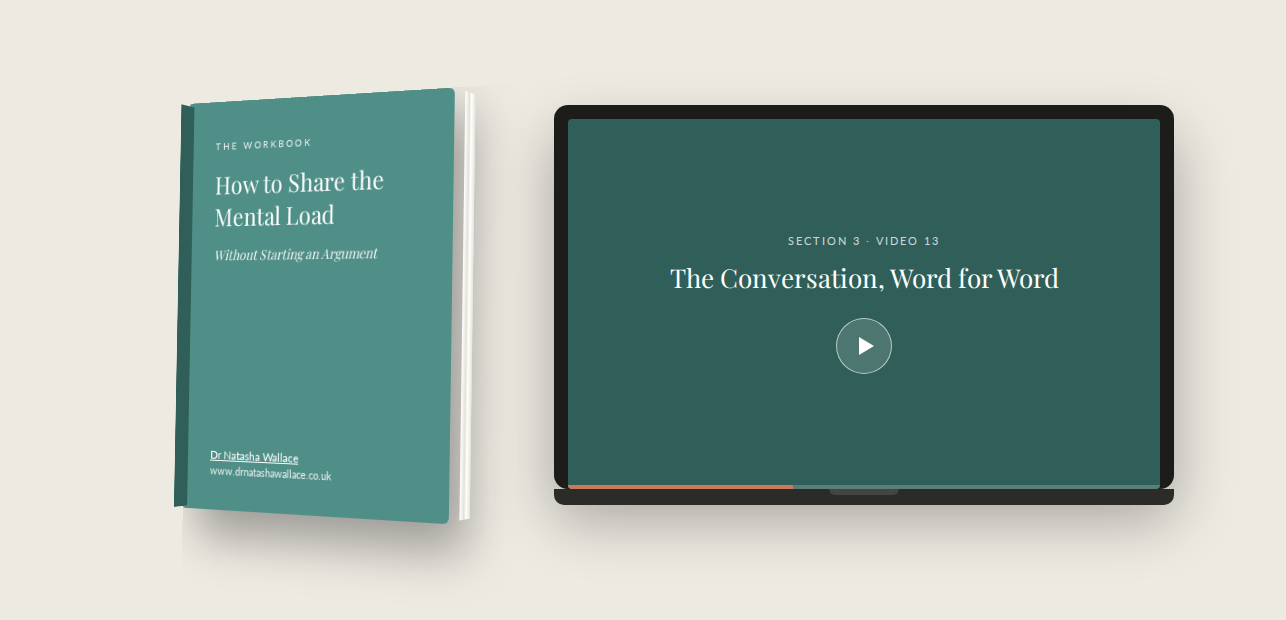
The exact, word-for-word conversation, including what to say if you get pushback, defensiveness, guilt-tripping, or silence.
Section 4 - The Long Game
Why it might creep back (and that's normal if it does), and the systems that actually make it stick.
Plus 3 bonus videos:
- Equal doesn't mean identical - why 50/50 isn't actually the goal, and what to aim for instead
- It's not just your partner - the load you're also carrying for kids, in-laws and friend groups, and what to do about this.
- The mental load at work - why you're doing this in the office too!
Plus the workbook, so you can map it all out on paper instead of in your head.
Get The CourseSo - if you're the one who remembers everything in your house, and you'd quite like to not be, this is the bit that actually helps.
Get the whole course
for £27
Less than a third of one therapy session.
- 19 short videos across 4 sections
- 3 bonus videos
- The workbook to map your own mental load
- The word-for-word conversation script
One payment. Lifetime access.
And if it doesn't help, you get your money back.
Take 14 days. Watch it, do the workbook, have the conversation. If nothing shifts, email me and I'll refund you - no forms, no awkwardness, and you can keep the workbook.
You don't have to keep holding all of it
You've tried the vague version of this conversation. This is the specific one.
Four sections, one afternoon, and a plan for your actual house, this week.